


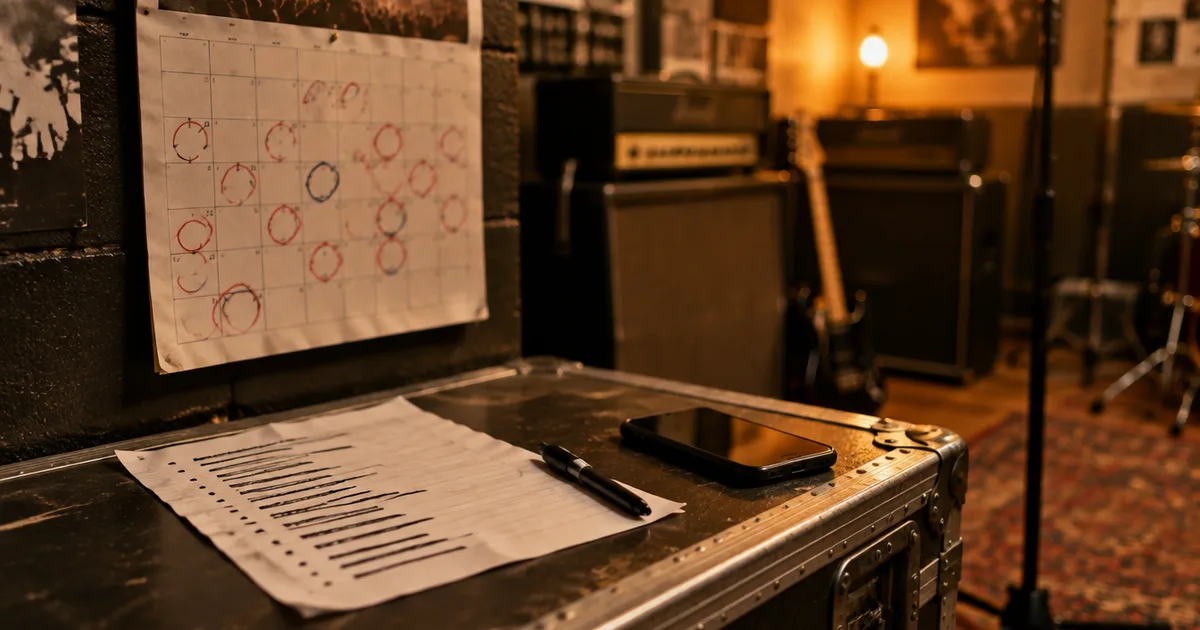
A booker clicks your calendar. The most recent thing on it is from last spring.
They close the tab. You never hear from them, and you never find out why.
Meanwhile you played four times in the last six weeks. Nobody updated the page, because updating the page is the least interesting job in the band and it never belongs to anybody in particular. That one neglected page does more damage than any other thing on a band’s website, and fixing it is a five-minute-a-week habit.
What a Stale Calendar Says
Put yourself on the other side of it.
You are considering a band. You open their dates and the last one listed was fourteen months ago. What do you conclude?
Not “they are busy and forgot to update the site.” You conclude they stopped working. Maybe they broke up. Maybe they are not very good. Nobody gives a stranger the benefit of the doubt, and the page has told a clear story whether you meant it to or not.
An empty calendar is worse than no calendar at all. That is the uncomfortable part. If the page exists and it is blank, it is actively making an argument against you, and it is a page bookers reach within the first thirty seconds.
Past Dates Are Proof Too
Most bands delete a gig the day after they play it. Do not do that.
Your past dates are the single best evidence you have. A list of rooms you played over the last two years tells a booker more than any bio ever will, and it does it without you having to make a single claim about yourself.
So keep an archive. Upcoming dates at the top of the page, past dates below, ideally collapsible so the page does not get long. If you have played a hundred shows, show the last twenty and link the rest.
A booker scanning that list is looking for names they know. When they find two, they stop reading and start thinking about which night to offer you.
What Every Listing Needs
Five things, every time, in the same order.
- The date, including the day of the week. People think in "Friday," not in "the 14th."
- The venue name.
- The town. This one gets skipped constantly and it matters for people finding you in search.
- The start time, or at least "doors at 8."
- A link: tickets, the venue's event page, or the Facebook event.
Private events go on the calendar too, and this is the trick most bands miss. List them as “Private event, [town]” with no venue and no link. You have shown a booker you were working that Saturday without telling the world where somebody’s wedding was.
That small habit fills the gaps that make a calendar look thin, and it is entirely honest.
Five Minutes a Week
Here is the discipline, and it is the whole thing.
One person owns the calendar. Not the band, not whoever remembers. One name.
Every time a gig is confirmed, it goes on the page that day, before the confirmation email gets buried. Once a week, that person checks the page for anything that moved or got cancelled. Five minutes, usually less.
If your site is on a system where updating means editing code, that is a problem worth fixing, because a page that is annoying to update is a page that will not get updated. Any decent setup gives you a form for this. If yours does not, ask whoever built it, or ask me.
The failure mode is never laziness. It is ambiguity about whose job it is.
Make Every Date Shareable
Last piece, and it costs nothing.
Every listing should be something a person can send to a friend. That means the link works on a phone, the page does not require anybody to log in, and ideally each show has its own address you can paste into a message.
It also means your calendar is the thing you link to in every social post, every newsletter, and every pitch email. One page, kept current, doing the work in twenty places.
When somebody asks “where are you playing next?” the answer should be a link you can send without checking anything first. That is the test. If you have to look it up before you can answer, the page is not doing its job yet.
And all of this only works if the calendar lives somewhere you control, at an address that will still be yours in five years. Not on a social profile, where the dates disappear into a feed within a day of posting them.