There are ninety people in the room and they are all having a good time. In two hours they go home, and you have no way to reach a single one of them again.
That is the part that stings. Not the empty rooms. The full ones you never followed up on.
Every gig is a chance to turn a crowd into a list, and it costs you one small sign and one sentence from the stage. That is the entire setup. The bands who do it walk out with a dozen new names on a good night, and the bands who do not walk out with a story about how great the crowd was.
The Crowd Is Already There
You will never again have this many interested people in one place at one time.
They came out. They paid a cover or bought a drink. They are, by definition, the easiest people in the world to convince that they should hear about your next show. Compare that to trying to reach a stranger on the internet who has no idea who you are.
So the highest-value marketing you do all month happens between nine and midnight, on a night you were playing anyway. The list you build there outlasts every algorithm, and it starts with people who already like you.
Where the QR Code Goes
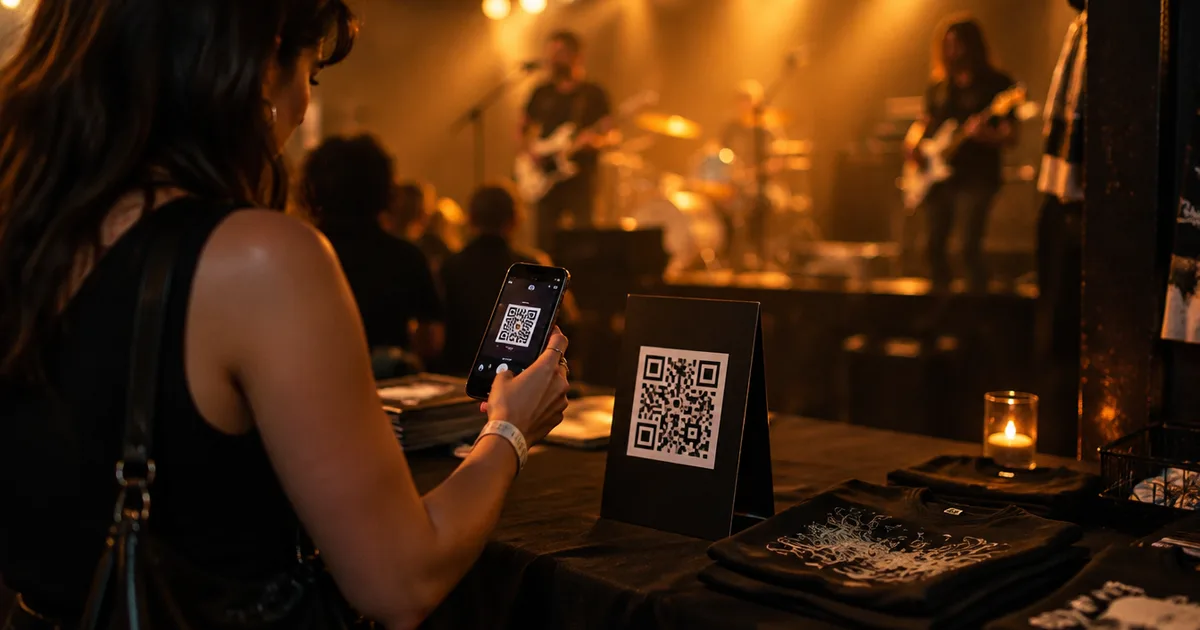
Make a QR code that points at a signup page on your own website. Not a social profile, not a third-party form with somebody else’s branding on it. Your site, your address.
Then put it where people already stop.
- A table tent on the merch table, standing up, big enough to scan from a couple of feet away.
- A card taped to the front of a monitor wedge at the edge of the stage.
- The back of a business card or a sticker you hand out.
- A slide on any screen the venue is running.
Two rules for the sign itself. Make the code big, because people scan from farther away than you expect in a dark room. And put one line of text above it that says what they get, not what you want. “Show dates, first” works. “Join our mailing list” does not.
Test the code on your own phone before the gig, in low light, from about three feet. Then test it again after you print it.
What to Say From the Stage
One sentence, once, in the middle of the set.
Not at the very end. At the end, half the room is finding their coats and the other half is settling a tab. Mid-set is when people are standing still and paying attention, and it costs you about six seconds.
Say something like this, in your own words:
“If you want to know where we’re playing next, there’s a code on the merch table. Scan it and we’ll email you the dates. That’s it, we’re not going to bother you.”
Then play the next song. Do not oversell it, do not come back to it three more times. Asking once, confidently, works better than asking four times apologetically.
If somebody in the band is better at talking than the rest of you, that person says the line. Every time. It becomes part of the set, like the count-off.
Give Them a Reason to Join
“Join our mailing list” is a chore you are handing a stranger. Give them something instead.
The easiest reason is first access. Dates before they go public. A heads-up when you are playing their town. People who liked the show genuinely want that, and it is completely true, which makes it easy to say.
A clip works too. A live video of the song they just watched you play, sent the next day, is a better trade than any discount you could offer. It costs you nothing and it proves the email is worth opening.
What does not work is vague generosity. “News and updates” means nothing. Be specific about what lands in their inbox and how often, then keep that promise.
Send the Welcome Email That Night
This is the step almost everybody skips, and it is the one that makes the whole thing work.
Set up one automatic email that goes out the moment somebody signs up. Write it once. It runs forever.
Thanks for scanning that code tonight. Real quick: we’re a four-piece out of [town], we play [the kind of rooms you play], and the only thing you’ll get from us is a short note when we have dates near you.
Here’s where we’re playing next: [link to your calendar]
See you at one of them.
That email arrives while they are still in the parking lot, still in a good mood, still remembering the second set. Two weeks later, cold, it lands very differently.
The habit is what matters more than any of the details. Sign on the table, one line from the mic, welcome email waiting. Do that at every gig for a year and you will have an audience you can reach on purpose, instead of hoping the right people happen to see a post.